
math makes sense 9 pdf
Math Makes Sense 9 PDF: A Comprehensive Guide (Updated April 15, 2026)
Math Makes Sense 9 offers accessible learning, providing solutions for students, educators, and parents alike. It delivers instant help with algebra, geometry, and fundamental mathematical concepts.
This resource bridges learning gaps and supports mathematical proficiency through readily available lessons and homework assistance, fostering a deeper understanding of core principles.
What is “Math Makes Sense 9”?
Math Makes Sense 9 is a comprehensive mathematics textbook designed specifically for students in the ninth grade. It’s a core component of many Canadian curricula, known for its clear explanations and progressive approach to building mathematical understanding. The textbook isn’t simply a collection of problems; it’s structured around a pedagogical philosophy that emphasizes conceptual learning before procedural application.
The “Math Makes Sense” series, in general, aims to make mathematics accessible and engaging for all learners. It achieves this through real-world examples, visually appealing layouts, and a consistent focus on problem-solving strategies. The Grade 9 edition builds upon foundational concepts from earlier grades, introducing more complex topics in a logical and manageable sequence.
A key feature is its emphasis on providing students with the tools to not only solve problems but also to understand why those solutions work. The availability of a PDF version expands access to this valuable resource, allowing students to study anytime, anywhere, and utilize digital tools for enhanced learning. It provides free math lessons and homework help from basic math to algebra, geometry and beyond.
Target Audience and Curriculum Alignment
The primary target audience for “Math Makes Sense 9” is students enrolled in Grade 9 mathematics courses, typically aged 14-15. However, its clear explanations and structured approach also make it beneficial for students who require additional support or are revisiting foundational concepts. Educators utilize it as a central resource for lesson planning and assessment, while parents can leverage it to assist their children with homework and reinforce learning at home.

Regarding curriculum alignment, “Math Makes Sense 9” is specifically designed to meet the requirements of the mathematics curriculum in many Canadian provinces, including Ontario, Alberta, and British Columbia. It covers essential topics such as algebra, geometry, measurement, data analysis, and probability, aligning with provincial learning outcomes and standards.
The PDF version maintains this alignment, ensuring students using the digital format are still receiving instruction that corresponds to their classroom learning. It offers free math lessons and homework help, supporting students, teachers, and parents in achieving academic success. The resource provides solutions to math problems instantly.

Availability of the “Math Makes Sense 9” PDF
Finding a legitimate PDF version of “Math Makes Sense 9” can be challenging. While the complete textbook isn’t typically offered as a free, official download, various resources provide access to specific chapters or supplementary materials. Educational platforms and school-provided digital learning environments often host the PDF for enrolled students, offering a secure and legal avenue for access.

However, numerous unofficial sources claim to offer the full “Math Makes Sense 9” PDF. These sources range from file-sharing websites to online forums. It’s crucial to exercise extreme caution when utilizing these platforms, as they often harbor malware, viruses, or copyright-infringing content.
The availability fluctuates, and links can become broken or lead to compromised files. Remember that accessing copyrighted material without proper authorization is illegal and unethical. Free math lessons and homework help are available, but full textbook PDFs require careful sourcing. Students should prioritize official channels provided by their schools or educational institutions.
Legality and Ethical Considerations of PDF Downloads
Downloading a PDF of “Math Makes Sense 9” from unauthorized sources raises significant legal and ethical concerns. Copyright law protects the textbook’s content, granting exclusive rights to the publisher. Obtaining a copy without purchasing it or having explicit permission constitutes copyright infringement, a violation with potential legal ramifications.
Ethically, supporting authors and publishers by acquiring materials legally ensures the continued creation of valuable educational resources. Unofficial downloads undermine this system, potentially impacting the quality and availability of future textbooks. Furthermore, websites offering pirated PDFs often engage in questionable practices, exposing users to malware and security risks.
While free math lessons and help are readily available online, accessing the complete textbook requires respecting intellectual property rights. Prioritizing legal avenues, such as purchasing the textbook or utilizing school-provided digital access, demonstrates academic integrity and supports the educational community. Consider the impact of your choices on the creators and the future of educational materials.
Official Sources for Obtaining the Textbook
To ensure a legitimate and secure copy of “Math Makes Sense 9”, several official sources are readily available. The primary source is directly through the publisher, Nelson Education, via their official website. Here, you can purchase physical copies of the textbook, as well as explore digital options, potentially including a licensed PDF version.
Major booksellers, both online and in physical stores, such as Amazon, Barnes & Noble, and Chapters Indigo, also carry “Math Makes Sense 9”. These retailers guarantee authenticity and often offer competitive pricing and shipping options. School bookstores represent another reliable channel, frequently providing textbooks at discounted rates for enrolled students.
Furthermore, some schools and educational institutions may offer digital access to the textbook through learning management systems or online platforms. Always prioritize these official channels to avoid copyright infringement and ensure you receive a high-quality, legitimate copy of the resource, supporting both your learning and the creators.
Unofficial Sources and Potential Risks
While the internet offers numerous avenues for obtaining a “Math Makes Sense 9” PDF, exercising extreme caution when utilizing unofficial sources is crucial. Websites offering free downloads often pose significant risks, including the potential for malware, viruses, and other harmful software embedded within the files.
Downloading from unauthorized platforms also carries legal ramifications, as it constitutes copyright infringement. This can lead to potential fines or legal action. Furthermore, the quality of these illegally distributed PDFs is often substandard, featuring missing pages, distorted images, or incomplete content, hindering effective learning.
These unofficial sources frequently lack the interactive features and supplementary materials found in legitimate versions. Prioritizing official channels guarantees a safe, legal, and high-quality learning experience. Remember, the convenience of a free download isn’t worth compromising your digital security or supporting illegal activities.
Key Topics Covered in Math Makes Sense 9
“Math Makes Sense 9” comprehensively covers a range of essential mathematical concepts designed to build a strong foundation for future studies; The curriculum begins with foundations of algebra, introducing variables, expressions, and basic equation solving techniques. This progresses into a detailed exploration of rational numbers, encompassing operations with fractions, decimals, and percentages.
A significant portion of the course focuses on linear equations and inequalities, equipping students with the skills to graph and solve these equations. Furthermore, the textbook delves into geometry and measurement, covering area, volume, surface area, and geometric shapes.
Finally, “Math Makes Sense 9” emphasizes data analysis and probability, teaching students how to interpret data, calculate probabilities, and draw meaningful conclusions. Through these topics, students develop critical thinking and problem-solving abilities, preparing them for advanced mathematical coursework.
Chapter 1: Foundations of Algebra
Chapter 1 of “Math Makes Sense 9” lays the groundwork for algebraic thinking, initiating students into the world of variables and expressions. It begins by defining variables and constants, demonstrating how to translate verbal phrases into algebraic expressions. Students learn to simplify expressions by combining like terms and applying the order of operations – a crucial skill for success in algebra.
The chapter then progresses to introduce the concept of equations, emphasizing the importance of maintaining balance when solving for unknown variables. Students practice solving one-step equations using inverse operations, building confidence and a solid understanding of fundamental algebraic principles.
Throughout the chapter, “Math Makes Sense 9” utilizes real-world examples and practical applications to illustrate the relevance of algebra, making the learning process engaging and accessible. This foundational chapter is vital for mastering subsequent algebraic concepts.
Chapter 2: Rational Numbers
Chapter 2 of “Math Makes Sense 9” delves into the realm of rational numbers, expanding students’ understanding beyond whole numbers and integers. It comprehensively covers fractions, decimals, and percentages, demonstrating the interconnectedness between these different representations of numbers.
Students learn to perform all four basic arithmetic operations – addition, subtraction, multiplication, and division – with rational numbers, including those with both positive and negative signs. The chapter emphasizes the importance of finding common denominators when adding or subtracting fractions and understanding the rules for multiplying and dividing signed numbers.
“Math Makes Sense 9” provides ample practice opportunities and real-world applications to solidify students’ grasp of rational numbers. It also introduces the concept of converting between fractions, decimals, and percentages, equipping students with versatile numerical skills essential for problem-solving.
Chapter 3: Linear Equations and Inequalities
Chapter 3 of “Math Makes Sense 9” focuses on mastering linear equations and inequalities, foundational concepts in algebra. The chapter begins by introducing variables and expressions, then progresses to solving one-step and multi-step equations using inverse operations. Students learn to isolate variables to determine their values, building a crucial skill for future mathematical endeavors.
The text clearly explains how to translate word problems into algebraic equations, enabling students to apply their knowledge to real-world scenarios. It then extends this understanding to linear inequalities, teaching students to represent and solve them graphically and algebraically.
“Math Makes Sense 9” emphasizes the importance of checking solutions to ensure accuracy and provides numerous practice exercises to reinforce these concepts. The chapter also covers applications of linear equations and inequalities, demonstrating their relevance in various contexts, fostering a deeper comprehension.
Chapter 4: Geometry and Measurement
Chapter 4 of “Math Makes Sense 9” delves into the world of geometry and measurement, building upon foundational concepts with practical applications. The chapter systematically covers topics like angle relationships, geometric constructions, and properties of two-dimensional shapes, including triangles, quadrilaterals, and circles.
Students learn to calculate perimeter, area, and volume of various geometric figures, applying formulas and problem-solving strategies. The “Math Makes Sense 9” PDF provides clear diagrams and step-by-step instructions to aid understanding, ensuring students can confidently tackle measurement challenges.
Furthermore, the chapter explores transformations such as translations, rotations, and reflections, enhancing spatial reasoning skills. It emphasizes the connection between geometry and real-world applications, like architecture and design, making learning more engaging and relevant. Numerous practice questions and examples solidify comprehension and build proficiency.
Chapter 5: Data Analysis and Probability

Chapter 5 of “Math Makes Sense 9” focuses on the crucial skills of data analysis and probability, equipping students to interpret information and make informed decisions. The chapter begins with methods for collecting, organizing, and displaying data using various graphs – bar graphs, line graphs, and circle graphs – fostering visual literacy.

Students learn to calculate measures of central tendency (mean, median, mode) and analyze data distributions. The “Math Makes Sense 9” PDF provides clear explanations and examples to illustrate these concepts. It then transitions into probability, exploring theoretical and experimental probability, sample spaces, and independent/dependent events.
Real-world scenarios are used to demonstrate the practical applications of probability, such as predicting outcomes in games or assessing risks. Numerous practice exercises and problem-solving activities reinforce understanding and build confidence in applying statistical reasoning. This chapter prepares students for future mathematical studies and everyday life.
Utilizing the PDF for Effective Learning
The “Math Makes Sense 9” PDF offers a versatile learning experience beyond the traditional textbook. Students can benefit from its portability, accessing lessons and practice exercises on various devices – laptops, tablets, or smartphones – facilitating learning anywhere, anytime. Effective use involves active engagement with the interactive elements, if available, and consistent practice.
Utilize the search function to quickly locate specific concepts or examples, streamlining revision and homework completion. Annotating the PDF with notes and highlighting key information enhances comprehension and retention. Regularly reviewing worked examples and attempting practice questions is crucial for solidifying understanding.
Furthermore, the PDF format allows for easy printing of specific sections for focused study. Combining PDF study with external resources, like online platforms offering additional support, maximizes learning potential. Remember, consistent effort and active participation are key to success.
Features of the “Math Makes Sense 9” PDF (Interactive Elements, Searchability)
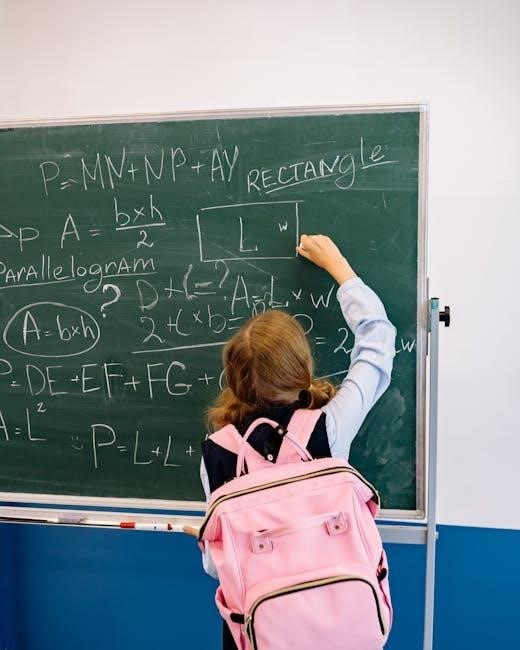
The “Math Makes Sense 9” PDF distinguishes itself through several key features designed to enhance the learning process. A primary advantage is its full-text searchability, allowing students to instantly locate specific terms, definitions, or example problems within the entire textbook. This saves valuable time during study and homework sessions.

Many PDF versions incorporate interactive elements, such as embedded videos demonstrating problem-solving techniques, or clickable links to supplementary online resources. These features cater to diverse learning styles and provide additional support. The digital format also enables zooming for clearer viewing of diagrams and equations.
Furthermore, the PDF allows for digital annotation – highlighting important concepts and adding personalized notes directly onto the pages. This fosters active reading and promotes deeper understanding. The convenience and accessibility of these features make the PDF a powerful learning tool.
Troubleshooting Common PDF Issues (Viewing, Printing)
When working with the “Math Makes Sense 9” PDF, users may encounter occasional technical issues. A common problem is difficulty viewing the document; ensure you have the latest version of Adobe Acrobat Reader or a compatible PDF viewer installed. If the PDF appears corrupted, try downloading it again from a reliable source.

Printing issues can arise from incorrect printer settings. Verify that your printer is selected, the paper size matches the PDF’s dimensions, and that you’re not accidentally printing in grayscale. For large files, consider printing in sections to avoid printer errors.
If interactive elements aren’t functioning, ensure your PDF viewer supports them and that JavaScript is enabled. Slow loading times can be addressed by closing unnecessary programs and increasing your computer’s memory allocation. Regularly updating your software can also prevent compatibility problems.
Alternative Resources for Math Support (Online Platforms, Tutoring)

While the “Math Makes Sense 9” PDF is a valuable tool, supplementing it with other resources can greatly enhance learning. Numerous online platforms offer free math lessons and homework help, covering topics from basic arithmetic to advanced algebra and geometry. Khan Academy, for example, provides comprehensive video tutorials and practice exercises.
For personalized assistance, consider online tutoring services. These platforms connect students with qualified math tutors who can provide one-on-one support and address specific learning challenges. Websites like Chegg and TutorMe offer convenient and affordable tutoring options.
Additionally, many educational websites provide interactive games and simulations to make learning math more engaging. Exploring these alternatives alongside the PDF can cater to different learning styles and reinforce concepts, ultimately leading to improved mathematical understanding and confidence.
Comparing “Math Makes Sense 9” to Other Grade 9 Math Resources
“Math Makes Sense 9” distinguishes itself through its structured approach and clear explanations, often favored for its step-by-step problem-solving guidance. Compared to more abstract textbooks, it prioritizes building a solid foundation in core concepts. However, other Grade 9 math resources offer different strengths.
Some textbooks emphasize theoretical understanding and proofs, potentially appealing to students who excel in abstract thinking. Online platforms like Khan Academy provide a vast library of video lessons and practice exercises, offering flexibility and personalized learning paths. These resources often complement textbook learning effectively.
Ultimately, the best resource depends on individual learning preferences. “Math Makes Sense 9” excels in providing accessible practice, while alternatives may suit students seeking deeper theoretical exploration or a more dynamic learning experience. Combining resources can create a well-rounded approach.